Going on Giests: The Progresses of King Henry VIII and his Wives
One of the most interesting features of the Tudor court was the summer progresses. At the time of the “grass season” from July to October the nobles and gentry would take leave from court to visit their country estates and supervise the harvest. Henry VIII would leave his palaces in London to go on tours and visit the houses of favoured courtiers where he would be entertained and go hunting with the local gentry. It was an important way for the monarch to be more visible and promote bonds of loyalty with his subjects. On 3rd August 1526 he visited Petworth in Sussex where “he had good game and recreation, entertaining those gentlemen who resorted to him in familiar manner and with good words, and presenting them with venison.”
Some of the written instructions (giests) for the itineraries survive for the years 1511, 1519, 1526, 1528, 1535 and 1541 and reveal the places where the king stayed and for how long. On the progress of 1526 Henry “had great cheer with my lord of Arundel, lord Delaware, lord Lisle, and here with my lord of Winchester.”
However, on 26th July he had to make a last-minute diversion in his journey to Winchester: "the King intended to have stopped at Stanstyd and Southwike; but as the parish in which the former stands is infected with plague, he will go to Warblington, a house of my lady of Salisbury, two miles distant. Thence he will go to Porchester Castle, and next day to Winchester."
On 18th August 1526 he was forced to make another change in his itinerary from Winchester to Ampthill due to an outbreak of plague at Woodstock: “Tuesday, 21 Aug., from Winchester to Thruxston, near Lisle's place, six miles. Saturday, 25th, thence to Ramsbury, 12 miles. Friday, 31 Aug., thence to Compton, 8 miles. Saturday, 1 Sept., thence to Langley. Tuesday, 11 Sept., thence to Byceter, 13 miles. Wednesday, 12 Sept., thence to Bukkingham, 10 miles. Thursday, 13 Sept., thence to Amptell, and there and at Grafton during the King's pleasure.”
In the summer of 1528 Henry fled from “The Sweat” in London and took refuge in a succession of remote country houses at Hunsdon, Tittenhanger, Ampthill, Grafton and Old Moor Hall in Sutton Coldfield to escape infection. On 30th June 1528 he “made his will and (has) taken the sacraments for fear of sudden death”. It was not until August that it was finally considered safe to return to London.
In the summer of 1531 Henry finally broke with Queen Catherine of Aragon. On 14th July 1531 he rode out of Windsor and went to Woodstock with Anne Boleyn leaving Catherine behind. She sent him a message regretting that she hadn’t been able to bid him adieu. But he replied that “he cared not for her adieux.” The chronicler Edward Hall wrote that, “after this day the King and she never saw together.” Catherine spent the summer alone at Windsor while the King and his favourite spent their time hunting in the parks surrounding the great forest of Windsor and being entertained at the houses of his friends. The Spanish Ambassador Chapuys reported that, “his object in taking the Lady with him to such hunting parties is that he may accustom the lords and governors of the counties and districts he traverses on such occasions to see her with him, and that he may the better win them over to his party.”
In the summer of 1535 Henry went on progress with his second wife Anne Boleyn and visited several prominent courtiers including Lord William Sandys at his property “The Vyne” and Sir William Paulet at Basing House in Hampshire. He also stayed for three days at the residence of the Seymour family at Wulf Hall in Wiltshire. It is possible that on this visit he first took notice of Jane Seymour who became his fourth wife in 1536.
On 30th June 1541 Henry set out on his Great Northern Progress up to York with his fifth wife Catherine Howard. During this progress Queen Catherine arranged several clandestine meetings in her rooms with Thomas Culpeper at Lincoln and Pontefract Castle. After their return from the progress on 30th October 1541 Henry celebrated All Saints Day with a prayer of thanksgiving “for the good life he led and hoped to (lead)” with the queen. However, the very next day Archbishop Cranmer informed him that allegations of misconduct had been made against her. This led to her execution for adultery on 13th February 1542.
What would it have been like to entertain the royal entourage at short notice when the giest had to be quickly adjusted? Here is a scene from my forthcoming novel: The Shadow of the Tower which describes the king's visit to Lady Margaret Pole at her house of Warblington:
In July 1526, the king and queen set out on an extensive progress through the counties of the south-west. He intended to visit his noblemen and take advantage of the good hunting there. But due to a sudden outbreak of the sweat at Stansted, he was forced to change his itinerary. He decided to bring his entourage to visit me at Warblington Castle instead. The first I knew of this intended visit was a breathless royal messenger arriving at my gate.
“His Majesty sends you his compliments, Lady Margaret,” he said. “His journey has been unexpectedly diverted and he requests the pleasure of your hospitality.” What could I say?
“Tell His Majesty that I would be honoured by his visit,” I replied. I ordered my steward to assemble the servants in the Great Hall immediately. I had a large household of seventy-three staff but they would all be needed to provide a suitable reception for the royal guests.
“The king and queen are on their way here for a visit,” I informed them. “We must prepare all the bedchambers with fresh linen. And we must replenish the storehouse and cellar with supplies of firewood and wine. Send wagons out to the nearest farms to fetch milk, eggs and cheese. And bring back fruit and beer if they have any in store. And get hay for the king’s horses. Tell the cooks to report to me immediately with sample menus. We must provide a suitable banquet for our guests when they arrive. They will need to begin preparing it at once.”
Naturally, my announcement caused a sensation. The house became a whirlwind of activity. The maids hurried to make the beds ready and the grooms rushed to polish the silver plate. The housekeeper unlocked her linen chests and personally supervised the preparation of the apartments for the king and queen. The steward sent ushers down to the cellar to bring out the best wines. The cooks were almost in tears over the lack of time to produce a royal banquet.
“My lady, we have rabbits and chickens, but no fish or small birds to set before their Majesties. There should be baked pies, fruit jellies and marchpane subtleties, but they would take hours to prepare.”
“The king knows it is short notice,” I said. “He will make allowances for the lack of special dainties. Just offer him the best that we have. I know we have some fine joints of beef, mutton and venison in the pantry. You can prepare a variety of roasted meats for the entourage. And make sure you bake plenty of manchet bread and sugared wafers for our guests.”
I sent for my chief musician. “You must gather the minstrels together and organise a worthy entertainment for the royal party. It does not matter if it is one that I have heard before. It only matters that we can manage to please their Majesties.”
By the time the royal party appeared, I was exhausted. I barely had time to put on my best gown and jewels and have my hair properly dressed. I waited beside the door in a black satin dress trimmed with marten fur and sable-lined sleeves. I knew I must not fail to do my duty to their Majesties. I heard the clatter of the horses’ hooves before I saw the royal heralds ride through the gates with their banners flying in the breeze. My steward followed me into the courtyard with goblets of wine ready to present to their Majesties. The king appeared upon his towering steed and quickly reined up and dismounted. I curtsied very low and the steward bowed his head while maintaining his grip on the winecups.
“Lady Margaret, it is too kind of you,” said the king genially. I was pleased to see that the king was in an excellent humour despite the disarrangement to his journey. But he always enjoyed seeing somewhere new.
“I hope your journey was not too tiresome, your Grace,” I replied. “It is splendid country around here. I hope to see more of it,” he said, looking around with interest.
“Will you take a cup of wine, your Grace,” I asked. “Yes, indeed, Lady Margaret,” he said, taking the cup and tossing it back. The queen’s litter drew into the courtyard. The king strode over and threw back the hangings.
“We are here now, my lady,” he announced. “You can take your ease.” I curtsied again. “I am most happy to welcome your Grace to my home,” I said to her.
“I am so thankful to be here, my dear Lady Margaret,” said Queen Catherine. “Our plans have been thrown quite out of place. I hope our coming here has not troubled you unduly.”
“Not at all, your Grace,” I said. “Would it please you to take a cup of wine?” “I would be glad to refresh myself. These roads are so dusty. But it does not seem to trouble the king.” She took the cup and sipped it gracefully. There was no sign of Mistress Anne Boleyn among the queen’s ladies. “He has sent her to Hever Castle to be out of danger,” she confided. “But he writes letters to her constantly. The messengers are getting exhausted from the long rides.”
“You see that he still cares about you, your Grace,” I said. “Otherwise, he would have left you behind in London.”
She shuddered at the thought. “Cardinal Wolsey has stayed at Hampton Court to keep charge of affairs. But I hear it is very bad there now. There have been many deaths already. I am glad to be away from the city.”
Henry was already walking around the courtyard directing the yeomen and knights where to put their horses. He had a habit of taking charge in every situation. Finally, he rejoined us. “This is a splendid castle, Lady Margaret. I see that you have been busy making improvements to it. You must tell me about them after supper.”
“I should be glad to do so, your Grace,” I replied. I had made a project of developing the castle into a fine residence and had furnished it just as luxuriously as the apartments of the queen. “Please come inside and my steward and I will show you to your apartments. My cooks have prepared a banquet for you. It will be served in the Presence Chamber as soon as you are ready to dine.”
“Excellent, Lady Margaret, said the king. “I knew a lady of your standing would not be disconcerted by the arrival of a few guests.”
“Your Majesty is always welcome to visit whenever you choose,” I replied. I escorted the king and queen to their apartments and sent the steward to fetch more wine for the king. My ushers led the royal attendants to their chambers. The royal guards and servants were provided with pallet beds and blankets in the garrets. An hour later, the king and queen were seated at the high table in the Presence Chamber and the feast was served. Their servants dined on trestle tables set up in the Great Hall. The banquet lasted for three hours and was followed by a performance by my minstrels. I prided myself that my musicians were just as good as those at court. I had a good knowledge of music and songs from my time in the households of the queen and the princess. I had trained my chief musician to arrange suitable programmes for all times and seasons of the years. He had the wit to present a selection of hunting songs for the king’s pleasure. I was pleased that my servants did not let me down.
“As I did travel all on a journey
Over the wayside and under a dark moon
Hanging above a mountain.
I spied a young man riding a fine horse
Chasing a white hart all through the woodland
There go the hunting and cries.
And there followed after ten kings and queens
Laughing and joking, the white hart they'd seen
Bounding away into the bushes.
A plume to his helmet, a quiver and a bow
There's nowhere to run now, there's no place to go
The hunter is fast and ready.”
King Henry and his companions were satisfied with their supper and their entertainment. Queen Catherine retired early with her ladies to allow the gentlemen to amuse themselves at gambling. My pages kept the wine flagons filled throughout the evening and late into the night as they challenged each other at cards and dice. I was relieved that the visit had gone so well. If my table or my pastime had been lacking then it would have been the talk of the court.
Mercifully, the king and queen only remained at Warblington for one night. My cooks prepared a lavish breakfast for the royal entourage. Then the king was eager to be on his way and catch up with his planned itinerary of hunting trips. The king and queen gave me their thanks and bade me a gracious farewell. I was relieved to see the great retinue departing through the castle gate on their way to Winchester. The local farms were already denuded of their produce. My steward had to ride around and compensate the farmers handsomely in silver for their losses.
Extract from "The Shadow of the Tower."
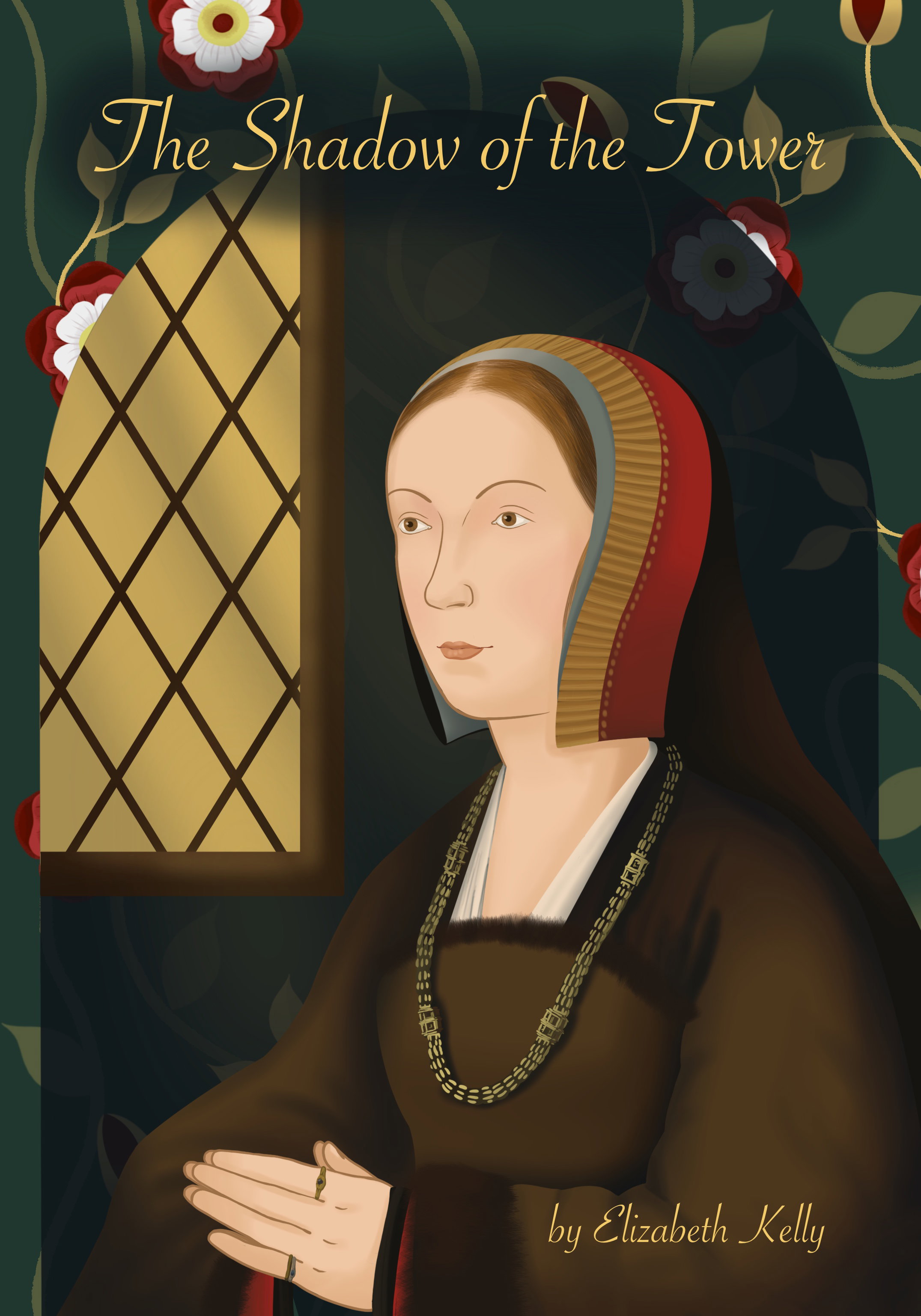
Book 5 in The Tudors Series